Lake Vista, the New Orleans Neighborhood That Traded Wrought Iron for Walls of Glass
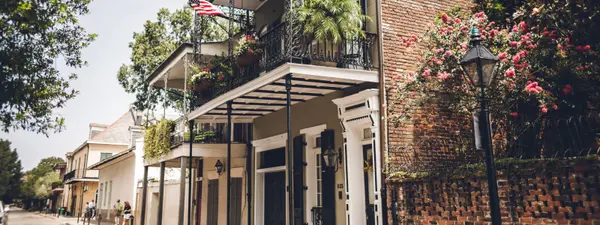
Picture the New Orleans a relocating buyer has already built in their head before they ever board a plane: iron lace balconies dripping over a French Quarter balcony, shotgun doubles in candy-box colors, a camelback addition stacked like an afterthought against the sky. It is a real city, and a lovely one. Then drive out toward the lakefront, turn off the main boulevard onto a street that curves back on itself instead of running straight, and the picture changes completely. Low, horizontal rooflines. Walls of glass facing a quiet lagoon. Not a shutter or a piece of decorative iron anywhere in sight. This is Lake Vista, and design-literate buyers who assume New Orleans architecture begins and ends with the postcard version are always a little startled to find it here.
The Garden City Plan Nobody Expects
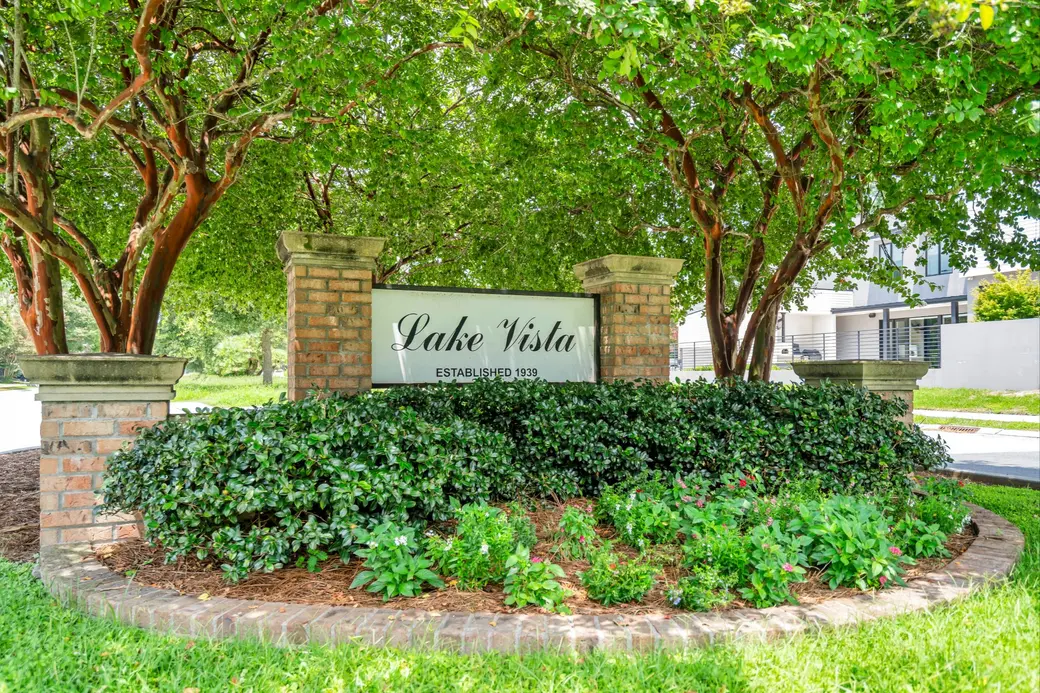
Lake Vista does not sit on the tight, rectilinear grid that defines most of the city's older neighborhoods, and that is by design. The neighborhood was planned in 1936 by engineer Hampton Reynolds for the Orleans Levee Board, built on land pumped in from Lake Pontchartrain itself. Rather than laying down another version of the standard New Orleans grid, Reynolds looked to the Garden City movement, borrowing directly from planned communities like Radburn, New Jersey. The result is a layout organized around long, curving super blocks, quiet culs-de-sac, and centralized greenspace instead of through streets.
Walking or driving it for the first time, that planning logic is immediately obvious. Streets bend around parks rather than slicing through them. Cul-de-sacs dead-end into greenspace instead of another block. For a buyer used to navigating New Orleans by counting cross streets, it takes a minute to get oriented, and that faint disorientation is part of the appeal. Lake Vista reads less like a neighborhood carved out of the city and more like a small, self-contained garden suburb that happens to sit inside Orleans Parish.
The Architects Who Turned It Into a Design Playground
The oddly shaped, generously sized lots that plan created turned out to be an unusual gift to the architects who came looking for them a generation later. In the postwar 1950s and 60s, Lake Vista became a genuine proving ground for Modernist residential design. Nathaniel "Buster" Curtis Jr., Arthur Q. Davis, and Albert C. Ledner all built houses there, and their work shares a clear vocabulary: glass walls that dissolve the boundary between indoors and out, flat or gently pitched horizontal rooflines, and floor plans oriented around light and lagoon views instead of a formal street-facing facade.
It is the same architectural moment, and largely the same design instinct, that produced the Modernist houses now celebrated in Palm Springs or Sarasota, just filtered through New Orleans humidity, New Orleans light, and a New Orleans lot shaped by a levee board's engineer rather than a Sunbelt developer. For a buyer who came here assuming the city's architectural range stopped at the shotgun house, Lake Vista functions as a quiet correction, proof that the city was experimenting with the same clean-lined Modernism as the rest of the country, just with its own accent.
Why It Survived When Other Areas Didn't
None of that architectural ambition would mean much if the neighborhood weren't also a genuinely sound place to put down roots, and this is where Lake Vista earns real credibility with buyers doing serious due diligence rather than falling for a roofline. The neighborhood sits on comparatively elevated land near the lakefront, and it largely escaped the flooding that devastated so much of the city after the 2005 levee failures. For relocating buyers who are researching flood history and elevation as carefully as they are researching architecture, that track record matters as much as any facade, and it is the kind of unglamorous fact that belongs in the same conversation as the glass walls and the lagoon views.
What It Costs and Who's Actually Buying
Pricing in Lakeshore-Lake Vista has moved depending on the exact window you measure, and it is worth being straightforward about that rather than quoting a single tidy number. Recent data puts the median sale price for the neighborhood somewhere in the $712,000 to $755,000 range over the trailing twelve months, with figures from different periods both pointing to a pullback from the prior year rather than a run-up. Well-restored or larger Modernist houses, particularly ones with a clear architect pedigree, regularly push well past $1 million.
The buyers showing up for these houses tend to be entrepreneurs, physicians, and design-minded transplants who want a New Orleans address with real architectural substance, without the wrought-iron ornamentation and formal parlor layouts of a Garden District mansion. They are not looking for a smaller or lesser version of historic New Orleans real estate. They are looking for a different one, and Lake Vista is one of the few places in the city built specifically to offer it.
Building a Life, Not a Spreadsheet
If you arrived in New Orleans assuming your choice was between a shotgun double downtown and a raised camelback somewhere in between, Lake Vista is worth a serious look before you settle on either one. The clean lines, the glass, the lagoon views: none of it is a departure from New Orleans, it is simply a chapter of the city's architectural story that rarely makes it onto a postcard. The real question is not which neighborhood counts as more authentically New Orleans. It is which one actually matches how you want to live, work, and see your own home every morning.
I would rather help you build a life here than help you fill out a spreadsheet, and that starts with an honest conversation about whether the wrought-iron version of this city you had pictured is really the one that fits you, or whether Lake Vista's clean-lined, design-forward sensibility is closer to what you actually want. If that sounds like your kind of New Orleans, I would enjoy talking it through with you.
Categories
Recent Posts